Hey there! As a diode supplier, I often get asked about the depletion region in a diode. It’s a pretty crucial concept in understanding how diodes work, so I thought I’d break it down for you in a way that’s easy to understand. DIODE
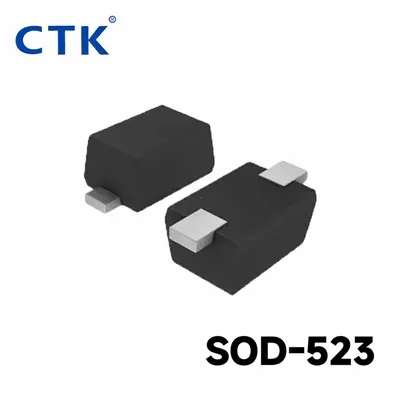
First off, let’s talk about what a diode is. A diode is a two – terminal electronic component that allows current to flow in one direction only. It’s like a one – way street for electricity. Diodes are used in a ton of electronic devices, from your smartphone to your car’s electrical system.
Now, the depletion region. To understand this, we need to know a bit about the structure of a diode. A typical diode is made up of two types of semiconductor materials: p – type and n – type.
The p – type semiconductor has an excess of holes (which are like positive charge carriers). On the other hand, the n – type semiconductor has an excess of electrons (negative charge carriers). When these two types of semiconductors are brought together to form a diode, something interesting happens at the junction between them.
At the junction of the p – type and n – type semiconductors, electrons from the n – type region start to diffuse into the p – type region, and holes from the p – type region diffuse into the n – type region. This diffusion process creates a region near the junction where there are no free charge carriers (neither electrons nor holes). This region is called the depletion region.
You might be wondering, why does this happen? Well, it’s all about the concentration gradient. In the n – type semiconductor, there’s a high concentration of electrons, and in the p – type semiconductor, there’s a high concentration of holes. Just like how heat flows from a hot area to a cold area, charge carriers flow from an area of high concentration to an area of low concentration.
As electrons from the n – type region diffuse into the p – type region, they recombine with holes. Similarly, holes from the p – type region recombine with electrons in the n – type region. This recombination process leaves behind immobile positive and negative ions in the depletion region. The positive ions are in the n – type side near the junction, and the negative ions are in the p – type side near the junction.
These immobile ions create an electric field across the depletion region. This electric field acts as a barrier to further diffusion of charge carriers. Once the electric field is strong enough, it stops the diffusion process. At this point, a state of equilibrium is reached.
Now, let’s talk about how the depletion region affects the behavior of the diode. When a forward bias is applied to the diode (that is, a positive voltage is applied to the p – type side and a negative voltage is applied to the n – type side), the external voltage opposes the electric field in the depletion region. This reduces the width of the depletion region. As the depletion region gets narrower, it becomes easier for charge carriers to cross the junction, and current can flow through the diode.
On the other hand, when a reverse bias is applied (a negative voltage to the p – type side and a positive voltage to the n – type side), the external voltage adds to the electric field in the depletion region. This increases the width of the depletion region. The wider depletion region acts as a very high resistance, and only a very small leakage current can flow through the diode.
The width of the depletion region also depends on a few factors. One of the main factors is the doping concentration of the p – type and n – type semiconductors. If the doping concentration is high, there are more charge carriers available for diffusion, and the depletion region will be narrower. Conversely, if the doping concentration is low, the depletion region will be wider.
Temperature also plays a role. As the temperature increases, the number of thermally generated charge carriers increases. This can cause the depletion region to change in width. At higher temperatures, the depletion region may become narrower because there are more charge carriers available to cross the junction.
Another interesting thing about the depletion region is its capacitance. The depletion region acts like a capacitor. The capacitance of the depletion region changes with the applied voltage. When the voltage across the diode changes, the width of the depletion region changes, which in turn changes the capacitance. This property is used in some applications, like varactor diodes, which are used in tuning circuits.
As a diode supplier, I know how important it is to understand the depletion region. It helps us choose the right diodes for different applications. For example, in high – frequency applications, we need diodes with a narrow depletion region so that the charge carriers can cross the junction quickly. In power applications, we might need diodes with a wider depletion region to handle higher voltages.
If you’re in the market for diodes, whether it’s for a small DIY project or a large – scale industrial application, understanding the depletion region can help you make an informed decision. Different diodes have different characteristics based on their depletion region properties, and we can help you find the perfect diode for your needs.
We’ve got a wide range of diodes in our inventory, from small signal diodes to high – power rectifier diodes. Each diode is carefully tested to ensure it meets the highest quality standards. And if you have any questions about the depletion region or how it affects the performance of the diodes, our team of experts is always here to help.
So, if you’re looking for reliable diodes and want to learn more about how they work, don’t hesitate to reach out. We’re here to assist you in finding the right diodes for your project and to provide all the technical support you need. Whether you’re a hobbyist or a professional engineer, we’ve got the diodes and the knowledge to meet your requirements.
Switching Diode References:
- "Semiconductor Physics and Devices" by Donald A. Neamen
- "Microelectronic Circuits" by Adel S. Sedra and Kenneth C. Smith
Tongke Electronic Co., Ltd
Tongke Electronic Co., Ltd. is one of the most experienced diode manufacturers and suppliers in China, featured by quality products and low price. Please rest assured to wholesale advanced diode made in China here from our factory. Contact us for pricelist.
Address: No.3,Chayuan Rd, Street 3, AilingKan, Dalingshan, Dongguan, Guangdong, China.
E-mail: jack@ctk-elec.com
WebSite: https://www.ctkchip.com/
